The 4-Step Isometric Layered Stack is a PowerPoint and Google Slides diagram designed to organize four levels, stages, or connected components within a clear vertical structure.
Diagram Preview
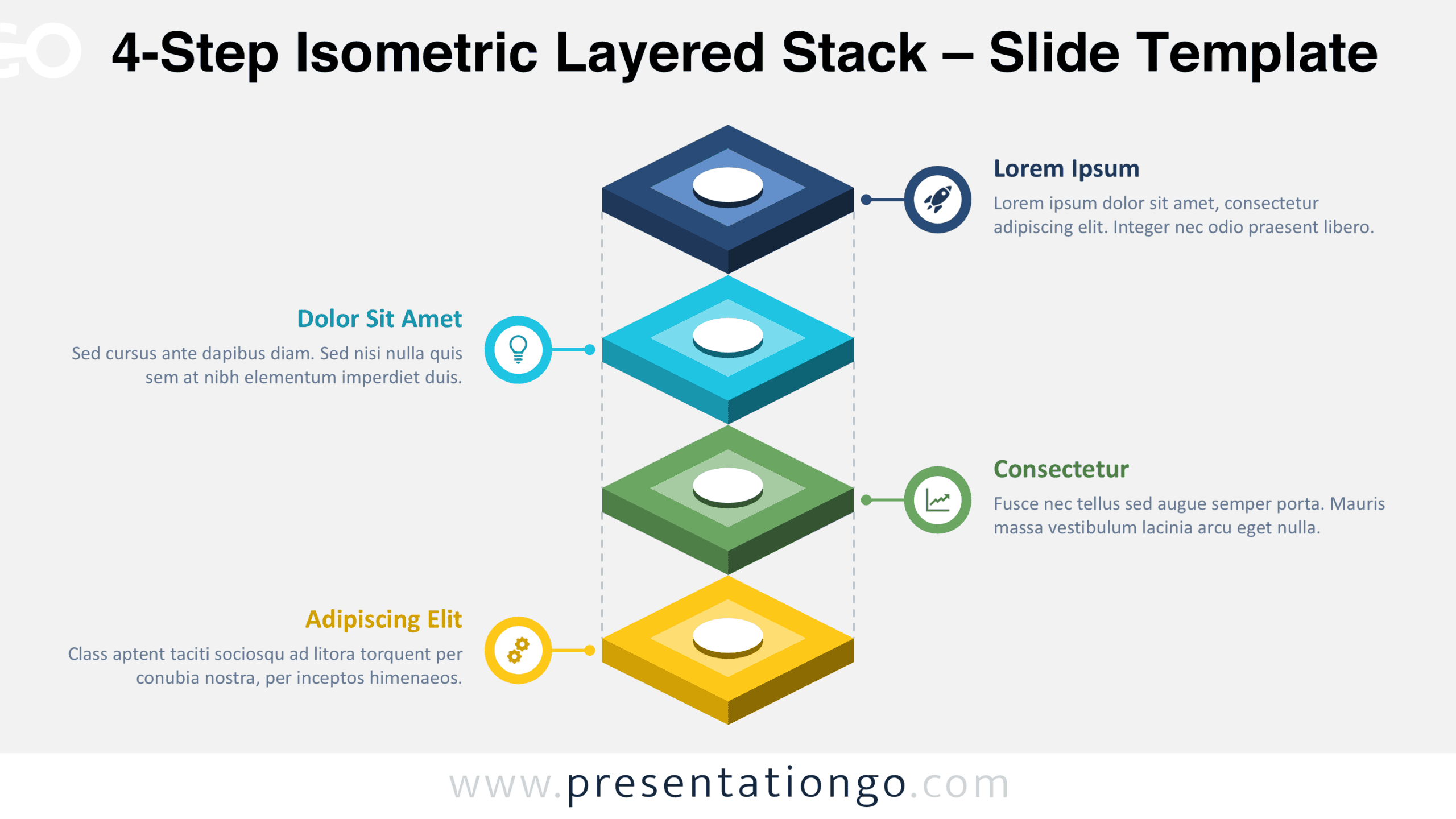
The preview displays four isometric platforms arranged in an exploded vertical stack, with alternating text annotations and circular illustrative icon placeholders. Two coordinated slides offer Light and Dark background options while preserving the same composition.


Features and Customization Options
- Slides: 2 slides with Light and Dark backgrounds
- Customization: Editable shapes, colors, and text
- Graphics: Scalable vector elements and replaceable illustrative icons
- Format: 16:9 widescreen
- Compatibility: Microsoft PowerPoint and Google Slides
Design and Structure
The diagram features four equal-sized square platforms arranged vertically in an isometric perspective. Each platform has a diamond-shaped appearance, with a recessed central square and a raised circular element. The layers occupy a shared central axis, creating an exploded-stack composition that separates individual components while maintaining their visual relationship. Consistent proportions and generous vertical spacing make each level easy to distinguish. Two dashed vertical guide lines reinforce the alignment of the stack and visually connect its separated platforms. Rather than relying on directional arrows, the arrangement establishes a natural top-to-bottom reading order.
Each platform connects to an adjacent circular icon placeholder through a short horizontal line and a small connection point. The accompanying annotations alternate between the right and left sides of the central stack. This alternating arrangement balances the composition and gives each level sufficient space for a heading and supporting description. The text blocks follow a consistent hierarchy, with prominent headings above smaller explanatory text. Repeated platform dimensions, aligned connectors, and evenly distributed annotations give the graphic a structured appearance without crowding the information. The diagram can represent a sequence of four stages or a collection of related levels, depending on the content assigned to each platform.
Practical Applications
- Process breakdowns: Present a four-stage workflow with a separate heading and explanation for each stage, guiding the audience through the sequence from top to bottom.
- Layered system architecture: Explain four system levels, showing how distinct components belong to a larger structure while preserving their individual roles.
- Organizational frameworks: Arrange four organizational tiers or functional layers, using the adjacent annotations to clarify responsibilities and relationships.
- Strategic planning: Divide a four-part strategy into clearly separated elements and summarize the purpose or contribution of each one.
- Project development: Describe four project phases, milestones, or implementation levels in a consistent visual format that supports concise progress explanations.
Summary
With its four separated isometric layers and balanced side annotations, this diagram provides a structured way to communicate multi-level information without sacrificing clarity or visual organization.