Quick summary
- Most presentations feel scattered not because the content is weak, but because the structure is wrong or missing entirely.
- The right framework depends on your goal: informing, persuading, inspiring, or moving an audience to action.
- Every strong presentation has the same three-part spine: a beginning that earns attention, a middle that builds the argument, and an ending that demands a response.
- You don’t need to invent your structure — the best ones have already been proven. Pick the right one and fill it in.
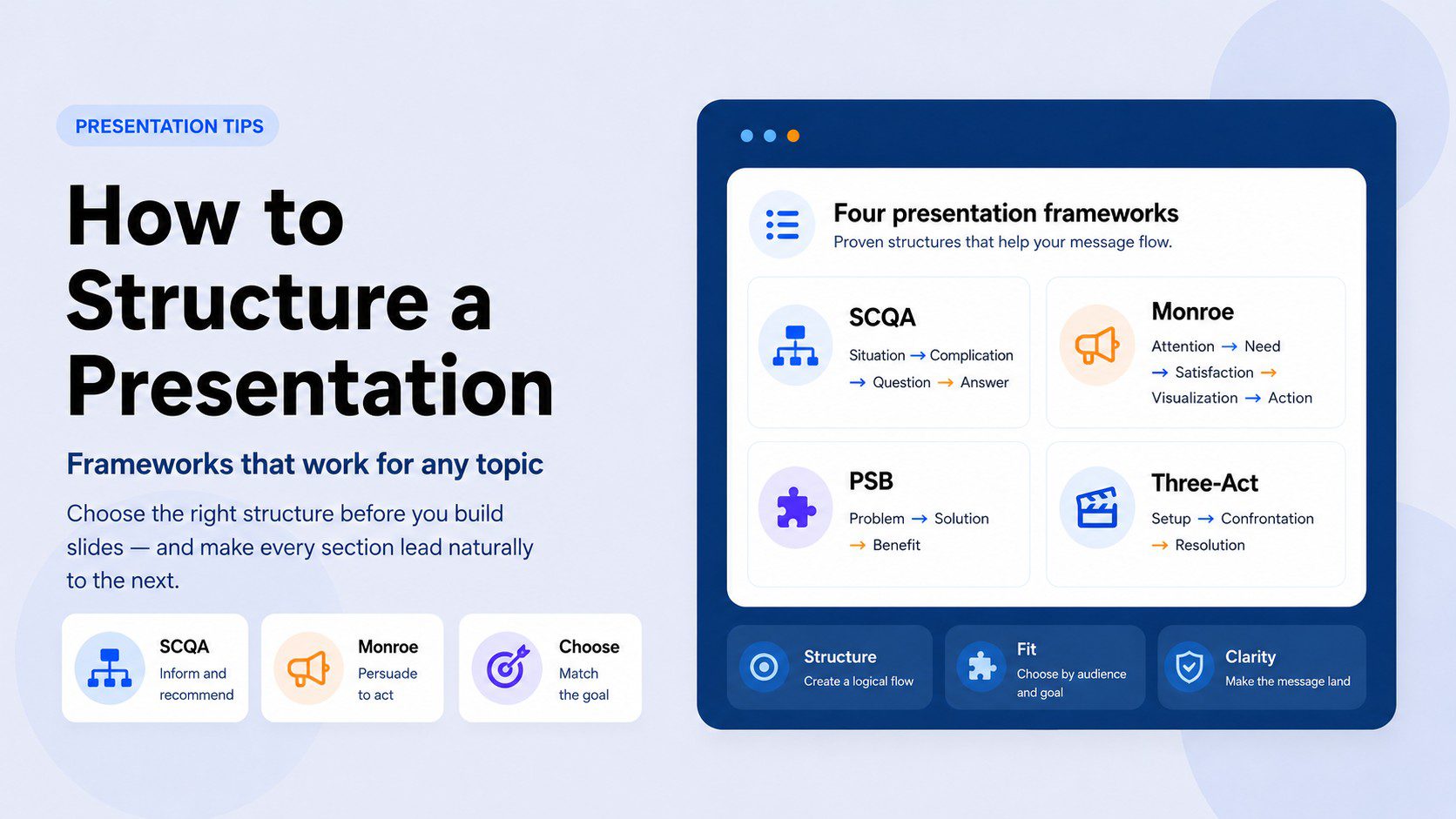
Four proven frameworks that give any presentation a clear structure — and how to choose between them
Most presentations don’t fail because the content is bad. They fail because the content has no structure — no clear reason why one point follows another, no sense of where the whole thing is going.
Structure is a decision you make before the first slide exists. Get it right early and everything else — the slides, the flow, the delivery — becomes faster and more coherent. The good news: you don’t need to invent a structure. The best ones have already been built, tested, and refined.
The three-part spine
The universal beginning-middle-end logic that underlies every framework on this list.
The right framework for your goal
How to match the structure to what you’re trying to achieve with this specific audience.
How to apply it in practice
Moving from framework to outline to slides without losing the structure along the way.
Quick overview
Jump to any section:
Why structure fails most presentations
Two structural mistakes show up in almost every weak presentation.
The first is building slides before deciding on structure. Most people open PowerPoint, create a title slide, and start filling in content — slide by slide, in roughly the order it occurs to them. The result is a presentation that reflects the order in which the presenter thought of things, not the order in which the audience needs to receive them. Those two orders are almost never the same.
The second mistake is choosing the wrong framework for the goal — for example, using an information-delivery structure when your goal is to persuade, or a storytelling structure when your audience needs a clear recommendation. In some cases there’s no structure at all, with the presenter simply hoping the content holds together on its own.
Structure is not the same as an agenda. An agenda tells the audience what topics you will cover. A structure, on the other hand, tells you — the presenter — how each section connects to the next and why the whole thing builds toward a specific outcome. One is a list. The other is a logic.
The universal spine: beginning, middle, end
Before getting into specific frameworks, every presentation — regardless of topic, length, or format — needs to do three jobs.
The beginning earns attention and establishes relevance. This means something that makes the audience want to keep listening — not an agenda, not a self-introduction. A sharp question, a surprising fact, a problem they recognize, a claim that demands to be proved. In other words, the opening’s job is to answer the question every audience member is silently asking: why should I pay attention to this?
The middle builds the case. This is where frameworks diverge most — different goals require different logic for this section. Even so, all of them share the requirement that each section must connect to the next. A middle that is just a list of related points is not a structure. A middle where each point prepares the ground for the next one is.
The ending demands a response — not a summary, not “thank you for listening.” Instead, it should be a clear statement of what the audience should now think, believe, decide, or do, ideally with a call back to whatever you opened with. The best endings feel inevitable, not like the presenter simply ran out of slides.
Structure is not a constraint on good content. It is the thing that makes good content land.
The SCQA framework: for informing and recommending
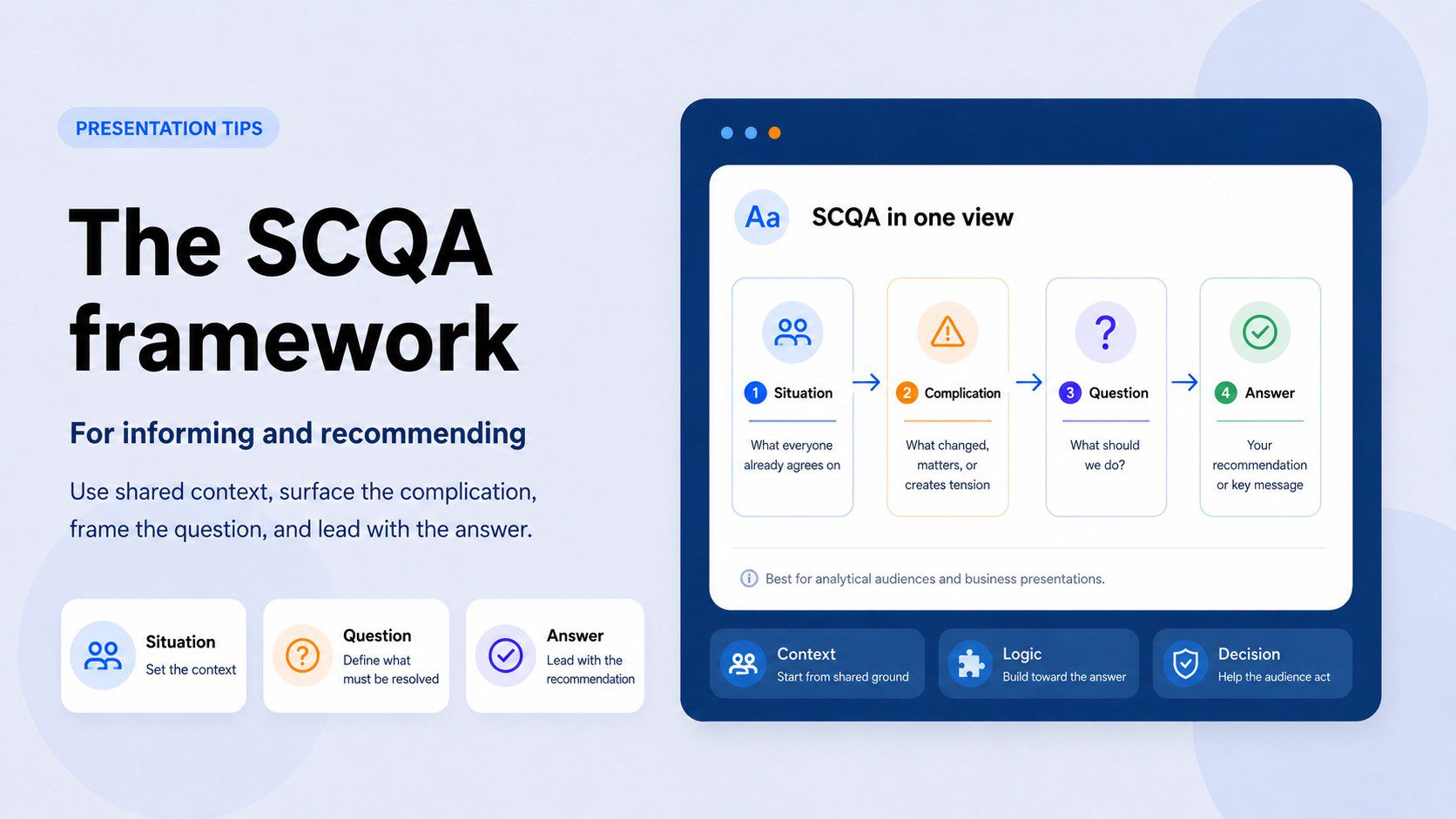
The SCQA framework — Situation, Complication, Question, Answer — was developed by Barbara Minto at McKinsey and remains the dominant structure for business presentations where the goal is to inform an audience and move them toward a decision.
It works by mirroring the way people actually process new information. Before someone can absorb an argument, they need context. Similarly, before they can accept a recommendation, they need to understand the problem it solves.
- Situation — establish the context your audience already recognizes. This is shared ground: facts about the current state that everyone in the room would agree with. Keep it brief.
- Complication — introduce the problem, change, risk, or opportunity that disrupts the situation. This is the reason the presentation exists.
- Question — the natural question the complication raises. Usually implicit: “So what should we do?” or “How do we respond?”
- Answer — your recommendation, finding, or key message. State it clearly and early, then spend the rest of the presentation proving it.
SCQA is particularly powerful for executive audiences who have limited time and need to understand your recommendation before they can evaluate your reasoning. It is the wrong framework for audiences who need to be emotionally convinced before they will accept a logical argument — for that, use Monroe’s Motivated Sequence.
Monroe’s Motivated Sequence: for persuading and moving to action
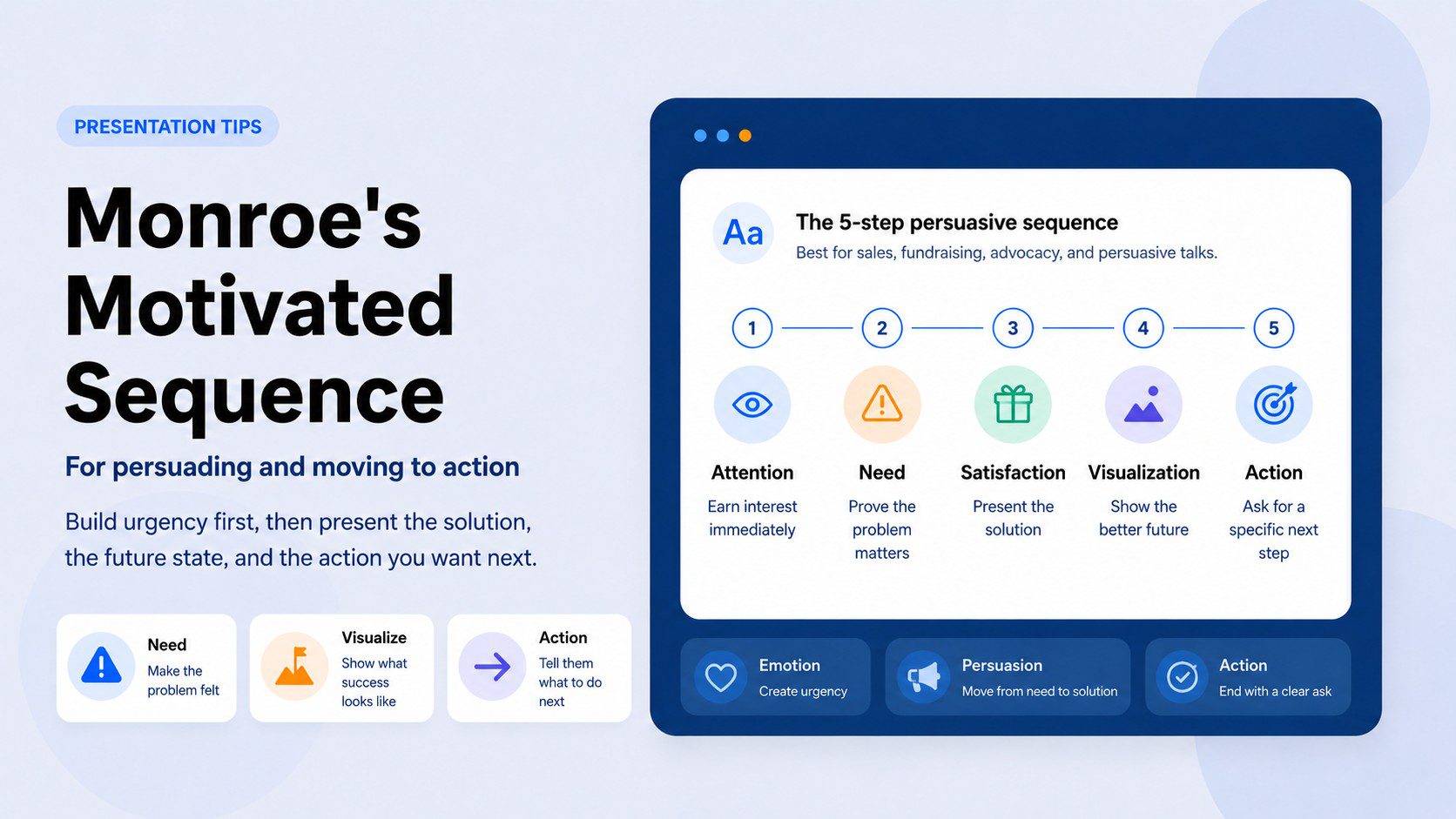
Monroe’s Motivated Sequence was developed by Alan Monroe at Purdue University in the 1930s and remains one of the most effective persuasive structures ever codified. It has five steps: Attention, Need, Satisfaction, Visualization, Action.
Where SCQA leads with the answer, Monroe’s sequence leads with the problem — and spends significant time making the audience feel it before offering the solution. This order matters because people don’t act on logic alone. They act when they feel the need is real and the solution is credible.
- Attention — open with something that breaks through the noise. A story, a statistic, a provocative question that makes the audience care immediately.
- Need — establish the problem in detail. Not just that it exists, but that it affects this audience specifically. The audience should feel the discomfort before you offer relief.
- Satisfaction — present your solution. Explain what it is, how it works, and why it addresses the need you’ve established.
- Visualization — help the audience see what success looks like. Describe the future state if they act, and optionally the continued pain if they don’t.
- Action — tell the audience exactly what to do next. A specific, immediate, achievable action — not a vague call to “consider” or “think about.”
Monroe’s sequence is the backbone of the best sales presentations, fundraising pitches, political speeches, and TED Talks. It is the wrong framework for an audience that has already bought in to the need — use SCQA or Problem-Solution-Benefit instead.
Why the sequence order matters
The sequence matters as much as the content. Monroe’s framework works because it follows the psychology of decision-making, not the logic of information delivery.
The Problem-Solution-Benefit structure: for pitches and proposals
The Problem-Solution-Benefit structure is the most stripped-down persuasive framework — three moves, clearly sequenced. Here is the problem. Here is the solution. Here is what it means for you.
Its simplicity is its strength. As a result, for startup pitches, project proposals, sales decks, and any presentation where the audience needs to make a decision quickly, PSB removes everything that isn’t essential.
- Problem — define the problem with enough specificity that the audience recognizes it as real and significant. A specific, well-evidenced problem produces genuine engagement. The best problem statements can be captured in one sentence.
- Solution — present the solution clearly and confidently. How does it work? Why does it address the specific problem you’ve defined? State it as a direct response to the problem.
- Benefit — shift from the solution to the value it creates for the audience. Not the features of the solution — the outcome. What do they gain, save, or avoid? This answers the question every audience member is privately asking: “What’s in it for me?”
PSB works best when the audience already understands the problem space and doesn’t need extensive education. If significant context-setting is required first, SCQA is a better fit.
The Three-Act structure: for stories and keynotes
The Three-Act structure comes from narrative theory — it is the backbone of virtually every story that has ever held an audience — and it translates directly into presentations where emotional engagement matters as much as the argument.
- Act 1: Setup — establish the world as it is. Introduce the context, the characters or situation, and the stakes. The audience needs to understand and care about the current state before they can be invested in what changes.
- Act 2: Confrontation — the problem, challenge, or journey. The longest section and the heart of the presentation. The confrontation is not a single moment but a series of escalating complications and partial resolutions that keep tension alive.
- Act 3: Resolution — the outcome, the lesson, the new state of the world. The resolution answers the question the setup planted. It should feel earned — the natural conclusion of everything that came before.
Nancy Duarte’s Presentation Sparkline, developed from studying the structure of the greatest speeches and presentations, maps directly onto Three-Act thinking: moving between “what is” and “what could be” to create the tension that keeps audiences engaged.
The Three-Act structure is the wrong choice for straightforward business recommendations, where the audience needs information efficiently rather than a narrative arc. For those contexts, SCQA is faster and cleaner.
How to choose the right framework
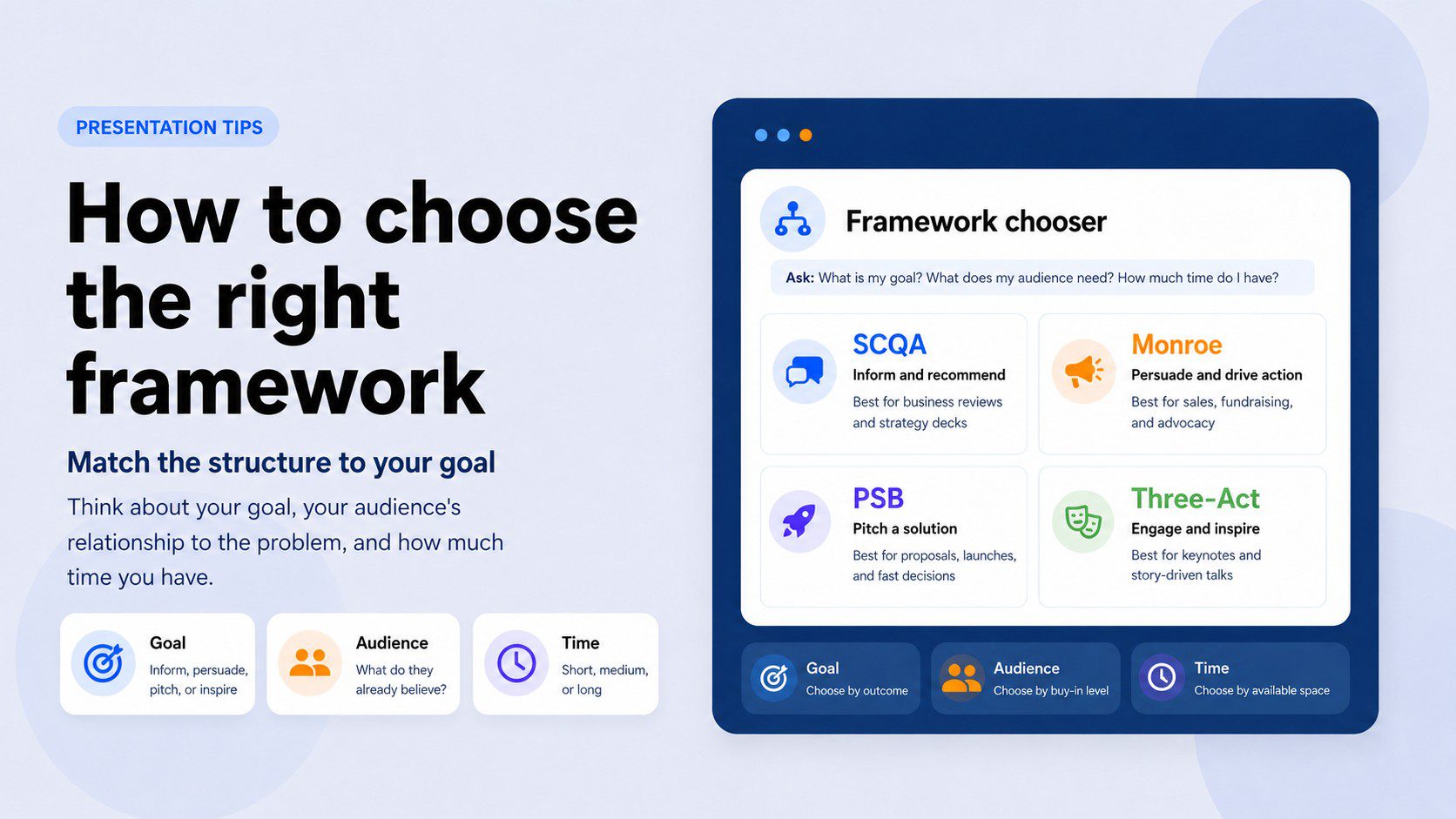
The decision comes down to three questions.
What is your primary goal? If you need to inform and recommend — use SCQA. If you need to persuade and drive action — use Monroe’s Motivated Sequence or PSB. If you need to engage emotionally and tell a story — use Three-Act.
What is your audience’s relationship to the problem? If they already recognize the problem and need a solution — PSB or SCQA. If they don’t yet feel the problem — Monroe’s sequence. If they need to be inspired rather than convinced — Three-Act.
How much time do you have? SCQA and PSB work at almost any length. However, Monroe’s sequence needs enough time to properly establish the need — it gets thin if rushed. Three-Act needs the most time of all; compressed, it loses the emotional resonance that makes it powerful.
Putting it all together
Structure is the first decision in presentation design, not the last. That means choosing the framework before you open PowerPoint, writing your outline before you design a slide, and knowing where you’re going before you start moving.
The four frameworks covered here — SCQA, Monroe’s Motivated Sequence, Problem-Solution-Benefit, and Three-Act — between them cover almost every presentation scenario you will encounter. Learn them, practice choosing between them, and the hardest part of any presentation becomes a five-minute decision rather than a two-hour struggle. Once the structure is clear, the slides follow naturally. Browse PresentationGO’s general presentation templates and timelines and planning slides for free starting points that give your structure the visual form it needs — for PowerPoint and Google Slides.
Quick reference: choosing the right framework
| Goal | Framework | Best for |
|---|---|---|
| Inform and recommend | SCQA | Business reviews, strategy decks, research readouts |
| Persuade and drive action | Monroe’s Motivated Sequence | Sales, fundraising, advocacy, TED-style talks |
| Pitch a solution | Problem-Solution-Benefit | Startup pitches, proposals, product launches |
| Engage and inspire | Three-Act Structure | Keynotes, conference talks, narrative-driven content |
Frequently asked questions
There is no single best structure — the right one depends on your goal. For business recommendations, SCQA (Situation, Complication, Question, Answer) is the most reliable choice. For persuasion, Monroe’s Motivated Sequence. For pitches and proposals, Problem-Solution-Benefit. For keynotes and storytelling, the Three-Act structure. The best structure is the one that matches what you are trying to achieve with this specific audience.
Start with something that earns attention immediately — a sharp question, a surprising statistic, a specific problem the audience recognizes, or a bold claim you’ll prove. Avoid starting with an agenda, a long self-introduction, or ‘Today I’m going to talk about…’ The opening’s job is to make the audience want to keep listening. Everything else comes after that.
SCQA stands for Situation, Complication, Question, Answer. It was developed by McKinsey consultant Barbara Minto and is the dominant structure for analytical business presentations. It works by establishing shared context (Situation), introducing the problem or change (Complication), framing the central question (Question), and then leading with the answer or recommendation before supporting it with evidence.
Monroe’s Motivated Sequence is a five-step persuasive structure: Attention, Need, Satisfaction, Visualization, Action. Developed by Alan Monroe at Purdue University, it is designed to move an audience from passive listening to committed action by establishing the need emotionally before offering the logical solution. It is the backbone of effective sales presentations, fundraising pitches, and advocacy talks.
There is no fixed rule, but allocate slides proportionally to importance rather than length. The opening and closing should each have at least one strong slide. The middle section should expand based on the complexity of the argument. A 20-minute presentation typically has 15–20 slides total, but the distribution matters more than the count.
A structure is the framework — the underlying logic that determines why one section follows another. An outline is the application of that structure to specific content: the actual topics, arguments, and evidence in order. You choose the structure first, then write the outline within it. Many presenters skip straight to the outline without choosing a structure, which is why so many outlines feel like disorganized lists rather than coherent arguments.
End with one clear takeaway and one clear next step. State explicitly what you want the audience to think, believe, or do. Then close the loop: if you opened with a question, answer it; if you opened with a story, return to it; if you opened with a bold claim, restate it with the evidence now behind it. The best endings feel inevitable — the natural conclusion of everything that came before.